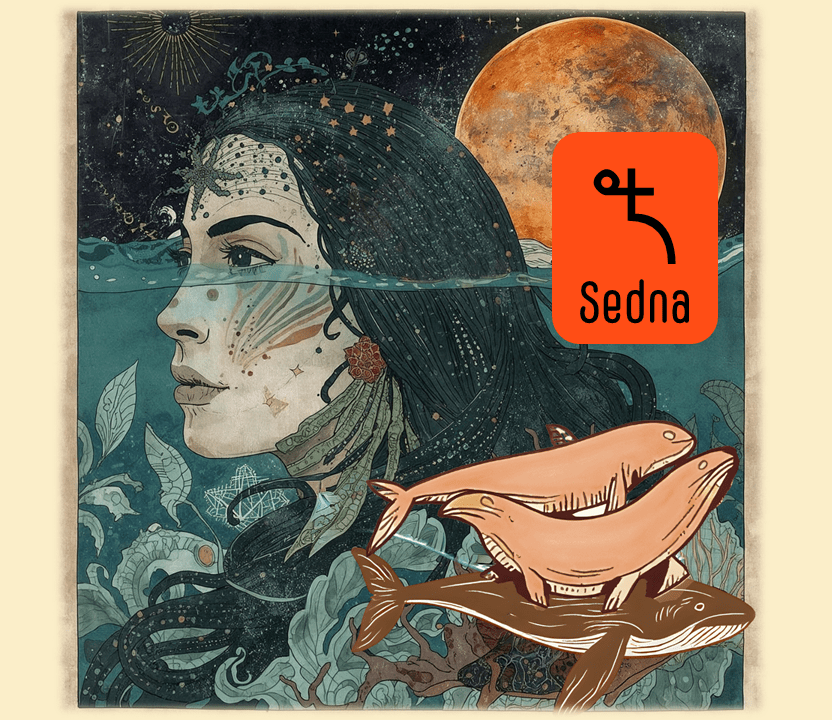
Beyond Neptune, in the outermost reaches of space, lies a vast, spherical ring of icy bodies and comets known as the Oort cloud – the ancient remnants of our solar system’s formation some 4.6 billion years ago. It is from this distant region in the periphery of our solar system that the Trans-Neptunian Object known as Sedna is thought to originate. Her discovery in 2003, at California’s Palomar Observatory, marked a pivotal moment in both astronomy and astrology.
A chance conversation with Christeen Skinner about Sedna in July piqued my curiosity about this mysterious ‘planet,’ and I’ve been pondering over her significance, both in mundane astrology and in the natal chart, ever since.
Up until now, I’ve not really worked much with the asteroids and centaurs outside of Chiron in my own practice. However, given recent events, especially the rise of violence against women and misogyny, I felt I needed to pay more attention to this astrological archetype. Especially given her recent ingress into Gemini (mid-June 2023) and her ongoing conjunction with Uranus (in orb now, but perfects in late May 2026).
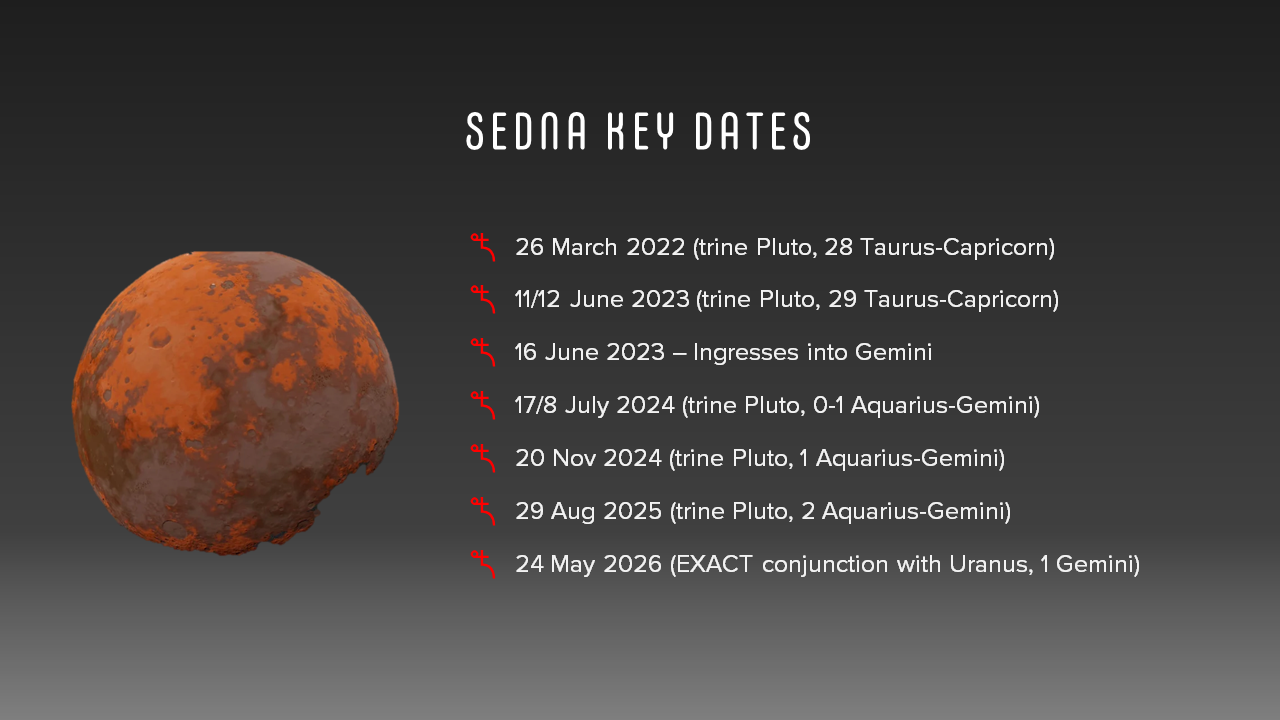
So, what exactly do we know about Sedna the planet? And how/in what context does she tend to show up in natal charts? That’s what I aim to explore in this blog post – and in the video (below) I’ve created especially for subscribers.
Inuit Goddess of the Sea
Named after the Inuit goddess of the sea, Sedna is a solitary but formidable figure, who dwells in the icy depths of the Arctic Ocean. Much like the planet, whose surface temperatures are equally icy – surface temperatures on Sedna are thought to hover around −240°C (−400°F). This is due to her extreme remoteness from the Sun, resulting in a freezing and harsh environment, not unlike conditions in the Arctic Circle.
In Inuit cosmology, Sedna is at once tragic and isolated but also powerful, governing over all marine life, especially the sea mammals like seals that are so essential to the survival of the Inuit people. As such she embodies the archetypal themes of isolation, transformation, but also personal power reclaimed through suffering.
Not Iron but Tholins
Sedna’s surface is also remarkably uniform and intensely red, likely due to tholins: complex organic compounds formed through the ultraviolet irradiation of simple carbon molecules thought to be among the primordial ingredients of life itself. The absence of visible surface impact features suggests Sedna has remained largely undisturbed for eons, a pristine witness to the solar system’s deep history.
Liminal Orbit
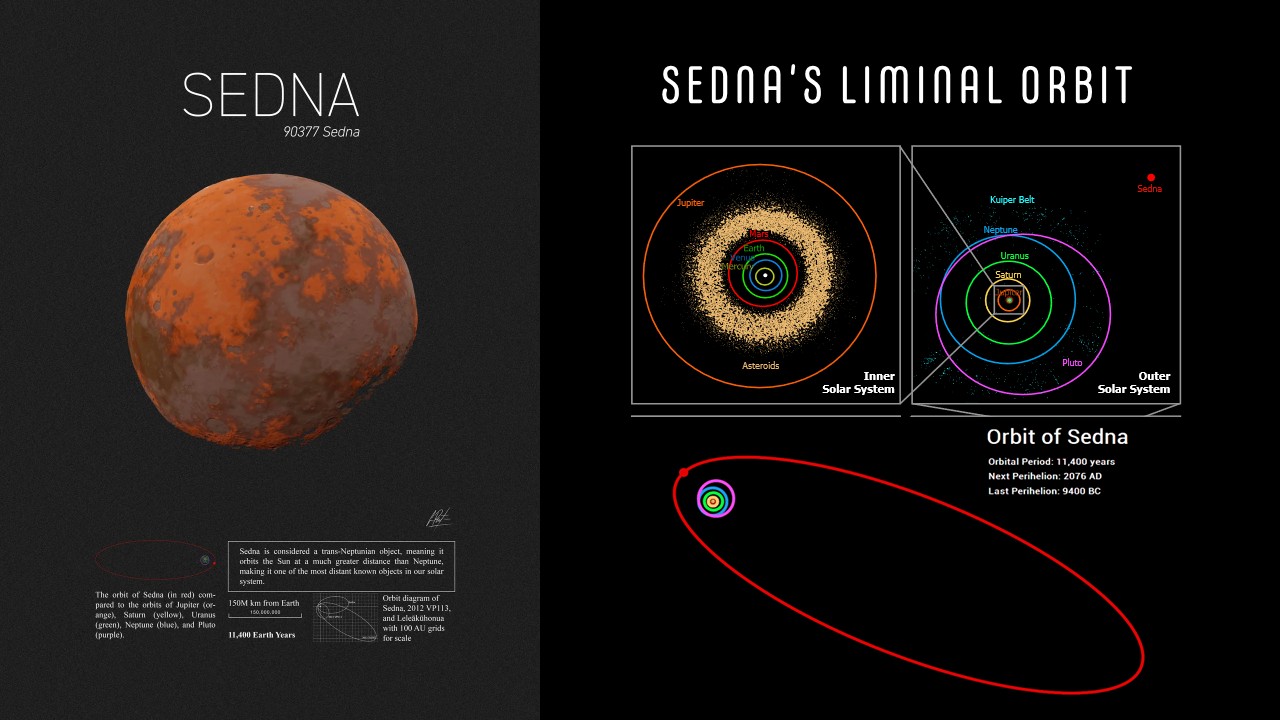
Sedna’s orbit is equally extraordinary — a vast, oval-shaped ellipse spanning approximately 11,400 Earth years, carrying her between the inner and outer, visible and invisible realms of the solar system. As such, Sedna inhabits a liminal space where traditional astronomical classifications begin to unravel, compelling astronomers to reconsider the boundaries and dynamics of our galaxy, the Milky Way.
Sedna as Astrological Archetype
As my conversation with Christeen highlights, Sedna is a very new planet in the astrological pantheon, and so her signature in a chart remains an area that is still open to interpretation. If you wanted to be scientific about it, you might say that we haven’t yet as a community collected enough data on the subject yet to come to any firm consensus yet.
Certainly, Sedna’s myth seems to invite reflection on themes like abandonment, marginality, exile, and resilience. Her story speaks of betrayal and isolation, and yet also about the reclamation of agency in the face of adversity.
On a more socio-cultural level, Sedna seems to illuminate profound themes of dismemberment, reclamation, and the abuse of power. Her myth centres on feminine forms of resistance and refusal: the withholding of sustenance, the power to say no, and the reclamation of agency through withdrawal.
In mundane astrology, Sedna appears to illuminate connections to deep, transpersonal wounds emerging from the collective unconscious, such as the abuse of the feminine in all its forms, including the health of the planet, and its oceans, that, like volcanoes, have been simmering away below the surface for some time, and then bubble up to the surface when triggered by a catalysing event.
But is this what we find when we test Sedna out in the charts? Well, if my conversations with Christeen and Ada, plus their experiences with clients, is anything to go by, then yes.
That being said, testing these theories out for yourself using celebrity charts to see whether this applies to their lives, can also be a very powerful testament to your initial findings. This is what I have done with first, Taylor Swift, and then Greta Thunberg, below.
Taylor Swift: Women, Money & Artistic Control
Sedna’s symbolism becomes especially compelling when we trace her presence in the charts of public figures who navigate complex relationships with visibility, power, and creative autonomy.
One such figure is Taylor Swift, whose chart reveals a striking Sedna configuration that seems to echo her lived experience, especially within the context of her career.
In Swift’s chart, the Sedna archetype seems to be reflected in her dignified but powerful resistance to contradictory societal expectations around women, careers and money; public vs private life; and in her firm establishment of boundaries around artistic ownership and the right to retain creative sovereignty – lessons she learned through bitter experiences that resemble those in the Sedna myth.
In a 2014 op-ed, she alludes to lessons she learned from these exploitative experiences, which reflect her Sedna in Taurus:
Music is art, and art is important and rare. Important, rare things are valuable. Valuable things should be paid for.
Later on in the same piece, she adds: “My hope for the future, not just in the music industry, but in every young girl I meet . . . is that they all realize their worth and ask for it.” But, of course, as America Ferrera reminds us, in her famous 2023 speech in Barbie: The Movie, as a woman living in a patriarchal system, “You have to have money, but you can’t ask for money because that’s crass.”
In the above video excerpt from my conversation with astrologer, Ada Pembroke, we explore Taylor’s natal chart, focusing on her Sedna placement, her 12th house Sun, and Pluto in the 10th house of career. We also look at Pluto’s T-square to her Leo–Aquarius nodal axis (ruled by the Sun and Uranus), which highlights the tension in her public life between her role as an activist, role model and/or spokesperson, on one hand; and on the other, her ‘job’ as a performer and entertainer – not to mention that classic Pluto themes, like control and reinvention.
The tension between her natal Sun, Uranus and Pluto is epitomized in this quote, from her documentary, Miss Americana:
“I want to love glitter and also stand up for the double standards that exist in our society. I want to wear pink and tell you how I feel about politics. And I don’t think those things have to cancel each other out.”
As you’ll hear, all these placements are reflected in her approach to creative ownership, public identity, the art of performance and the cultural narratives surrounding women, money and success.
Despite all the sniping by critics, in the end, Swift’s legacy can probably best be summed up by Sam Lansky:
“Maybe this is the real Taylor Swift effect: That she gives people, many of them women, particularly girls, who have been conditioned to accept dismissal, gaslighting, and mistreatment from a society that treats their emotions as inconsequential, permission to believe that their interior lives matter. That for your heart to break, whether it’s from being kicked off a tour or by the memory of a scarf still sitting in a drawer somewhere or because somebody else controls your life’s work, is a valid wound, and no, you’re not crazy for being upset about it, or for wanting your story to be told.”
Greta Thunberg: Anger turned into Activism
Greta Thunberg’s chart is another really clear case in point.
Born in 2003 – the same year that Sedna was discovered – and known for her scowl and open disdain for political rhetoric that never amounts to any meaningful action (who could forget the “How dare you!” speech?), Greta has a rather striking natal Sedna signature: an opposition between Sedna and her natal Venus-Mars conjunction in Scorpio. Given what we’ve heard about Sedna, female rage and righteous anger from people like Ada, this seems very fitting for a climate activist who fights for what she believes in: remedies for climate injustice and the way this impacts on indigenous communities, faster implementation of green energy infrastructure and more effective CSR practices.
Her noon chart also has Sedna rising on the Ascendant. However, because we don’t know her exact time of birth, it is hard to know if the angles and house placements in it are correct, so I don’t really want to comment further on
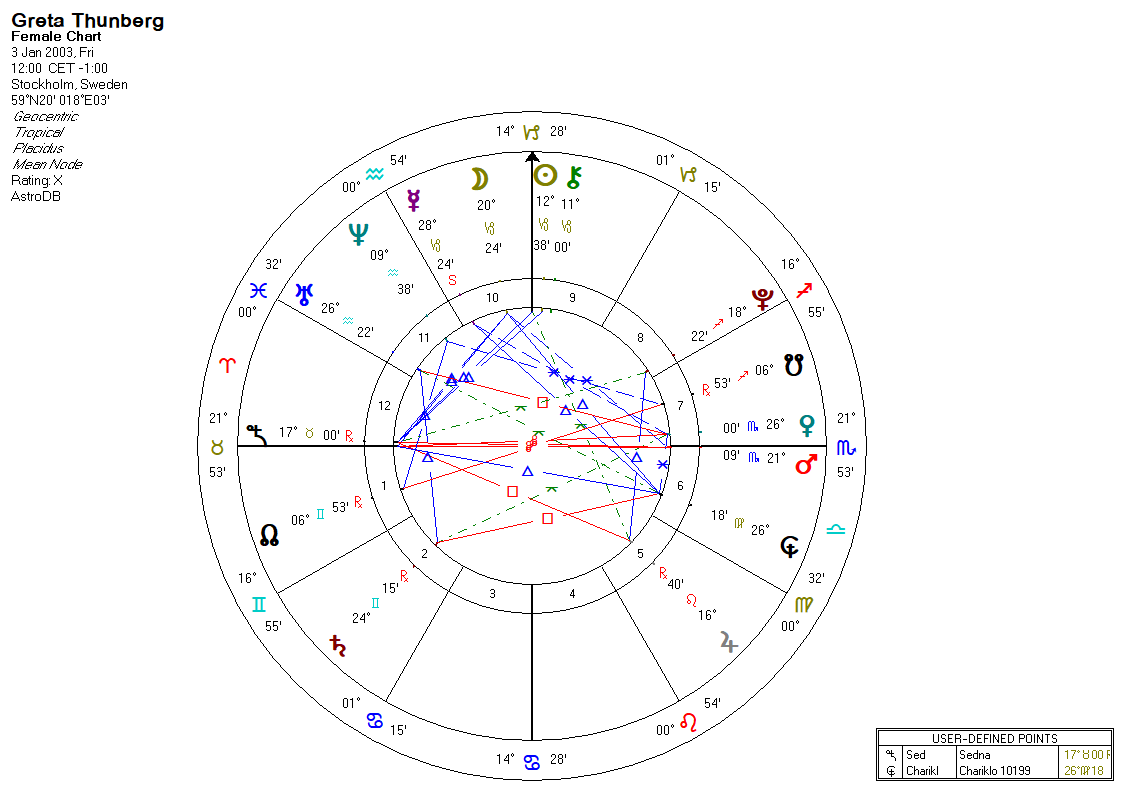
What we can say with more certainty is that Sedna is also square to her natal Jupiter in Leo, which might help to explain why she seems unafraid of clashing with world leaders, many of whom she obviously feels are all talk and no action. Here, Jupiter in Leo gives her the courage of her convictions, to push back against those who wish to maintain the status quo, and may have been the planetary inspiration behind her decision to set up a charitable foundation to promote her climate work.
Greta’s Jupiter also happens to be trine to her natal Pluto in Sagittarius, suggesting that she can channel these strong beliefs and convictions into forms of activism that have the potential to create powerful change. Given that Leo is also involved here, some of this activism may have a ‘performative’ aspect to them, whether in the form of marches, publicity stunts, and speeches.
Although this is something her critics find problematic, you could argue that this dramatic approach is essential to getting the media attention needed in order to raise awareness about certain issues, and is also a form of thought leadership, helping to set the tone or frame public discussion and debate when it comes to climate change and net zero. She also leads by example, often travelling to climate conferences via low-emission or carbon forms of transport, such as EVs and sailing vessels.
Most interesting, though, is the trine between Sedna and her natal luminaries, especially her Sun-Chiron conjunction: this suggests that she feels the pain of the Earth’s betrayal by us humans, and has made it her life’s mission to campaign on behalf of that which has no voice, via her climate protests and books as a result. To me, it also explains her early depression as a teenager and why finding a cause to get behind seems to have given her a new lease on life.
Implications for Astrology
In many ways Greta embodies what Ada meant when she suggested that people with strong Sedna placements often channel their rage into social justice – in Greta’s case, ecological justice and the defence of the planet’s resources for future generations. That activism is neatly aligned with Sedna in Taurus.
Christeen’s sense that Sedna matters for ocean health and climate issues also feels right: polar ice melt, sea-level rise, and ocean pollution from oil spills or nuclear accidents (think Fukushima) all fall squarely within Sedna’s symbolic territory.
I’ve also been thinking about Sedna’s forthcoming conjunction with Uranus, exact in 2026. Since my conversation with Christeen, I’ve begun to wonder whether Sedna is part of the pushback we’re seeing against unfettered AI development – the warnings from watchdogs, politicians, and critics about job displacement and human cost. Could Sedna be the archetype reminding us of the human price of disruptive technologies?
It’s striking that Sedna was discovered soon after the dot‑com crash, as the internet moved into widespread adoption. The planets she now contacts – Pluto in Aquarius, Uranus in Gemini, and Saturn-Neptune in Aries – are all associated with technological, scientific, and humanitarian shifts, which makes these connections worth closer study.
There’s clearly more research to be done to test these ideas. Watch this space.
Discover more from AstroInsights Blog
Subscribe to get the latest posts sent to your email.
