
It’s Gemini season, and in keeping with the spirit of Mercury, a planet that is all about liminality and transition, I’ve decided to change things up a bit.
So instead of doing yet another astrological transit, I’ve chosen to do an astrological profile on the life and legacy of a famous Gemini and larger-than-life figure in British astrological history – the 17th-century magus and alchemist, Elias Ashmole.
Brief Bio
Ashmole was an antiquary with a strong interest in astrology, alchemy and hermeticism, and the author of several books, including the well-known collection of English alchemical texts, Theatrum Chemicum Britannicum.
Although he was one of the first set of Fellows admitted to the Royal Society, a key institution in the development of experimental science, his interests remained primarily antiquarian and mystical in nature. He was an early freemason, although the extent of his involvement after his initiation in 1646 remains unclear.
He was also a keen collector of esoteric books and antiques, which he amassed in vast quantities after marrying his wealthy second wife in 1649, whose fortune gave him the means to indulge his acquisitive nature. Towards the end of his life, having no heirs and keen to preserve all the knowledge he had amassed for posterity, Ashmole donated his collection to the University of Oxford, to create the Ashmolean Museum – the first modern public museum in Britain.
Rather than repeat all the details of his biography here, which I outline in some depth in my podcast, together with an analysis of his horoscope; I’ve just decided to concentrate on the influence of the planet Mercury – and the trickster-like figure of the magician – on Ashmole’s life and thinking for this blog post.
Triple Gemini
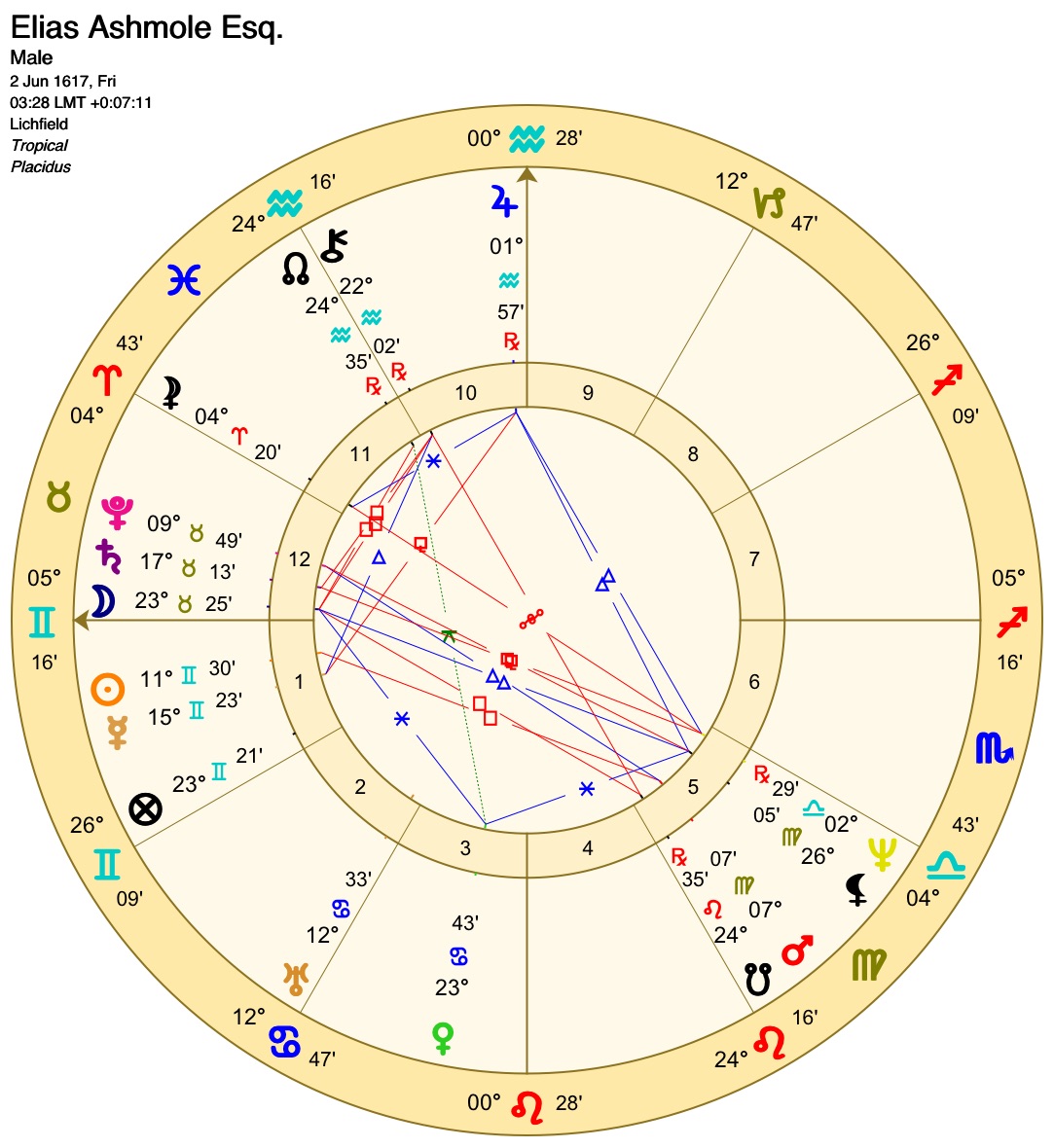
Elias Ashmole was born on 23 May 1617 (2 June in the Gregorian calendar) in Lichfield, Staffordshire, the only son of Anne and Simon Ashmole. His family had once been prominent in the area, but their fortunes had declined by the time of Ashmole’s birth. His mother was the daughter of a wealthy Coventry draper, Anthony Bowyer, and a relative of James Paget, a Baron of the Exchequer. His father, Simon (1589–1634), was a saddler, who had served as a soldier in Ireland and Europe. Elias Ashmole attended Lichfield Grammar School (now King Edward VI School) and became a chorister at Lichfield Cathedral before moving to London to study law, graduating in 1638.
His natal horoscope shows that he was born with the Sun and Mercury in the sign of the twins, and had Gemini rising, making him a triple Gemini.
William Lilly, Ashmole’s close associate, and a renowned astrologer in his own right, had the following to say about Ashmole’s natal disposition:
The favorable position of his natal Mercury [conjunct the Sun and in its own sign], endowed Ashmole with “admirable sharp fancys” (excellent wits and imagination), “extreme studious and capable of learning, guileful or wily, wise, wary, divining well, or giving good advice, acting all human affaires with great dexterity and judgement.” Lilly concluded that Ashmole’s genius was “naturally inclined” to the “Mathematicks, Astrology, Eloquence, to Magick and also to Musick,” and that he would “learn any Art with much ease.”
This is certainly a good assessment of Ashmole, who was a brilliant scholar of alchemy, astrology and many other aspects of natural philosophy; witty company, as well as a canny social operator who was always ready to make the most of whatever opportunities life threw his way.
Mercury & the Magus
In the tarot, the planet Mercury, associated both with the zodiac sign and the alchemical figure of Hermes, is also connected to the major arcana card of the Magician.
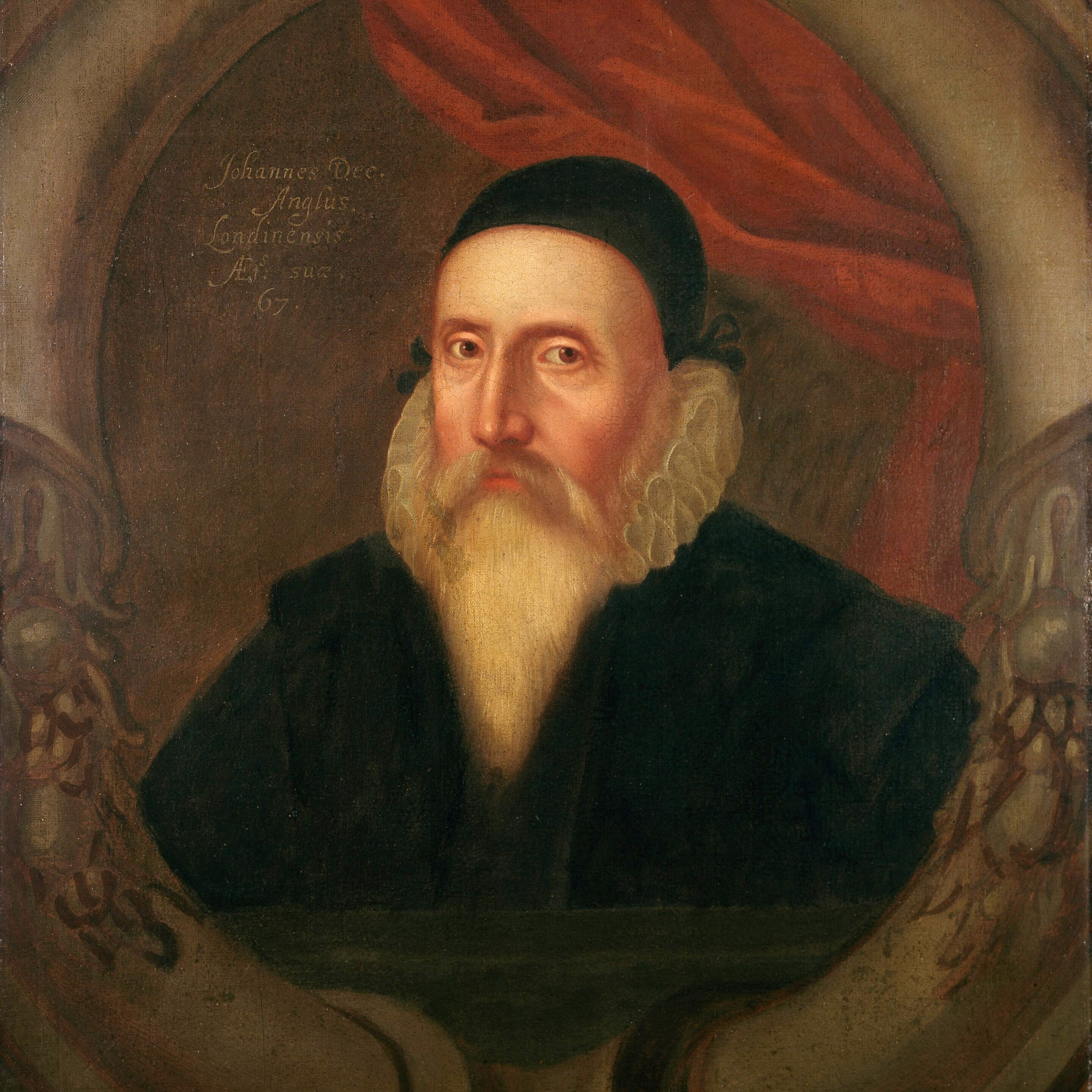
According to several of his biographers, the Magus figure is central to the way that Ashmole viewed himself. He was also a great admirer of John Dee, considered by many to be the inspiration for the magician Prospero in Shakespeare’s play, The Tempest.
Unsurprisingly, Ashmole was a voracious collector of Dee’s manuscripts, including the Monas Hieroglyphica, as well as a rare work, discovered posthumously in a hidden compartment of a wooden chest, detailing Dee’s controversial conversations with angels.
Recognising its value to the wider esoteric community, Ashmole ensured its preservation for posterity by publishing it under the title: A True & Faithful Relation of What Passed for Many Years Between Dr. John Dee and Some Spirits, thereby bringing Dee’s work on the Enochian language to a wider audience.
According to Tobias Churton, author of The Magus of Freemasonry, Ashmole modelled himself after the Renaissance Man, the well-rounded and brilliant polymath that came to be embodied in the figure of the Magus: an influential, charismatic if liminal figure “who dwelled at the center of Renaissance intellectual, spiritual, and scientific life.”
Much like the Renaissance intellectual and astrologer, Marsilio Ficino, the quintessential Magus “activated within himself an expanded humanity, allowing him to operate between the powers of earth and the active symbols of heaven.”
Tobias Churton believes that Ashmole took this all quite seriously. In true Hermetic style, he published a collection of English alchemical manuscripts under a pseudonym, but still managed to include several coded clues as to his ‘astral identity’ on the frontispiece, including references to his natal horoscope.

Ashmole also used the astrological glyph for Mercury as a codename for himself in his diaries – a habit he seems to have acquired whilst serving as an officer in the royalist army during the English Civil War. It was also during this period that some claim he became involved, like his hero, Dee, in intelligence work. So, we can see why cryptography might have appealed to him.
Magician as liminal figure
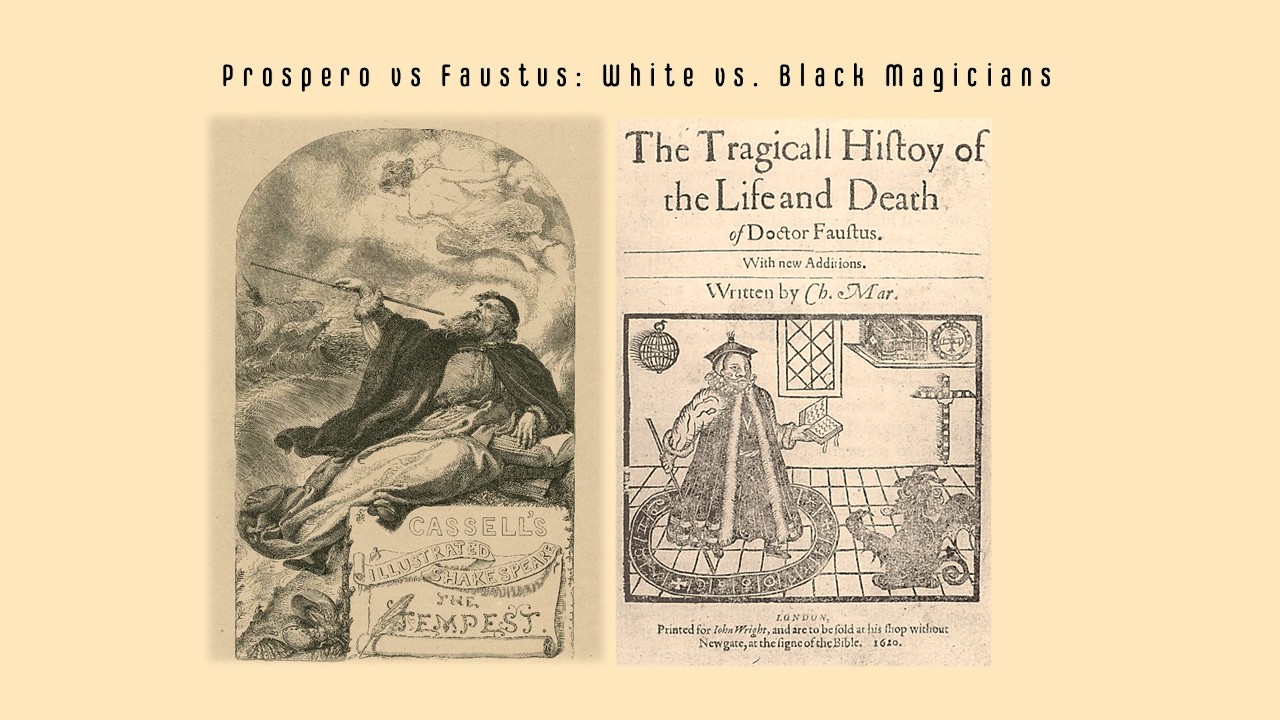
However, as the cautionary tales of both Marlowe’s Dr Faustus, and John Dee remind us, the Magus figure can be morally ambiguous, and has the potential to ‘go either way’: to work for the forces of good, like Prospero, or become a black magician like Dr Faustus – depending on whether or not he is able to control his desire for power and prestige.
Or, as Tobias Churton puts it:
Two contrasting classic literary examples of the image and of its power lie in Shakespeare’s Prospero (The Tempest) and Marlowe’s Dr. Faustus.
And it is this Geminian duality, and the contrast between the man vs. the myth, that I set out to examine in more detail, in this week’s episode of the AIP, which also happens to be No.5 in the series – a number closely associated with Mercury in Chaldean numerology.
However, rather than repeat everything I’ve already said in the latest episode of the Astro-Insights Podcast, I’ve decided to let the video (and all the image and archival research I did for this one) speak for itself. Check it out if you’re interested [see below].
Some highlights include: Ashmole’s Saturn Return and his initiation into freemasonry, his friendship with the astrologer, William Lilly; and his membership of the Royal Society.
Discover more from AstroInsights Blog
Subscribe to get the latest posts sent to your email.
