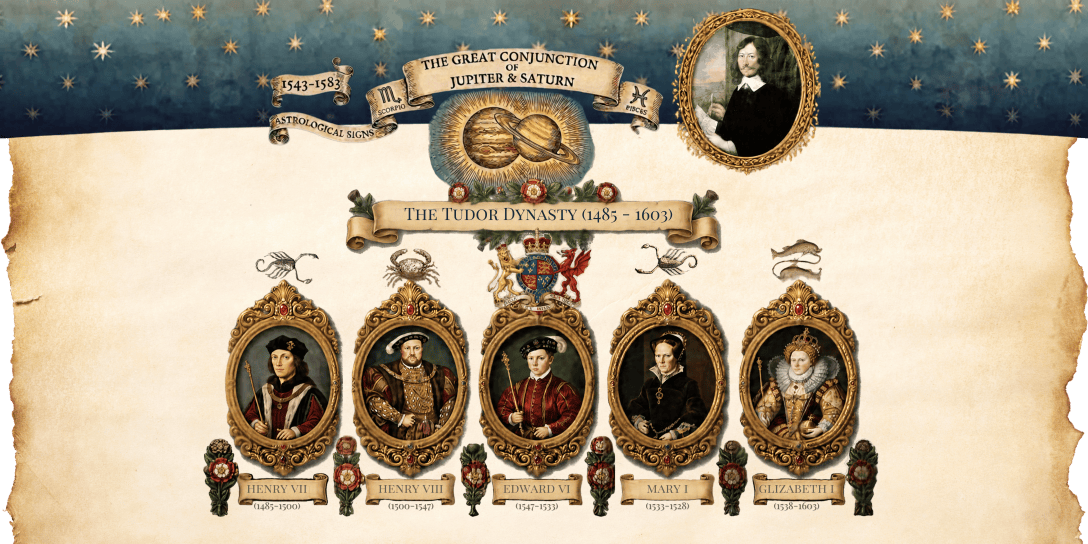
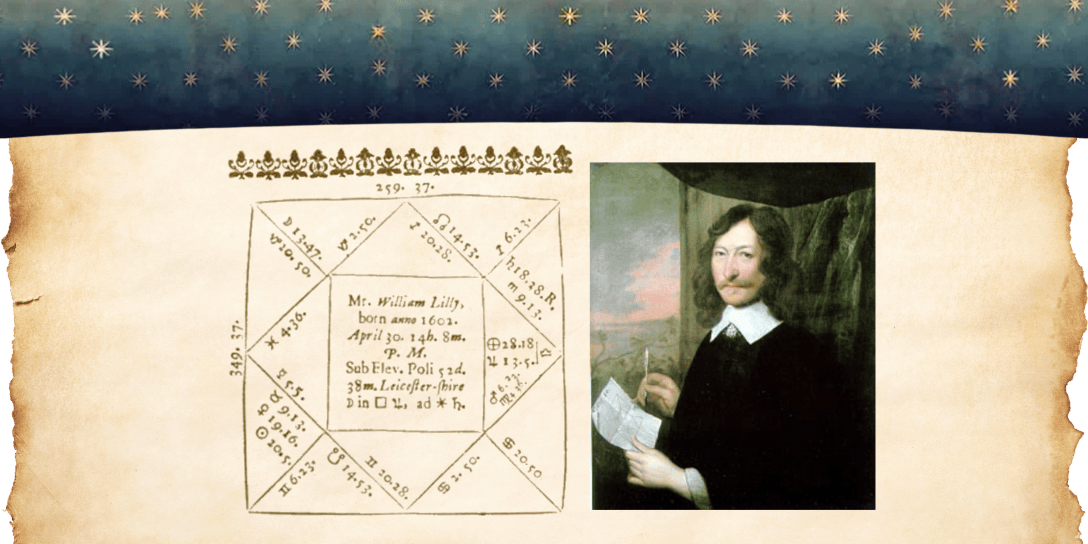
Every twenty years or so, Jupiter and Saturn meet in the sky. For centuries, astrologers have treated these so-called Great Conjunctions as markers of political, religious and cultural eras. Like a new moon, the conjunction itself signals the beginning of a new cycle, whilst the signs in which those meetings occur are thought to shape the character of the age that follows. Yet all cyclical theories of history face the same problem: much like history, astrology is often clearest in hindsight. As we discovered when talking to Marjorie Orr, who wrote a book all about these larger larger planetary cycles, and Christeen Skinner, who has written about America's potential future in one of her books, the challenge often lies in deciding what that hindsight allows us to say about the future. That was the challenge facing William Lilly when, writing his famous treatise on the Jupiter-Saturn cycle amidst the turmoil of the English Civil War, he decided to look back at the Tudor period and concluded that the Great Conjunctions revealed a meaningful pattern in English history. It was also the challenge facing Girolamo Cardano (aka Jerome Cardan) when he returned to Edward VI's horoscope after the young king's death and found meanings he had failed to see the first time around. In this article, I'm going to explore those questions through the lens of the Jupiter-Saturn cycle itself, and in particular the long sequence of water-sign Great Conjunctions that accompanied the rise and fall of the Tudor dynasty. In doing so, we'll revisit the astrology of William Lilly, hear about Girolamo Cardano (Jerome Cardan), Arthurian prophecy, and Andre' Barbault, and see how it all leads back to the surprisingly modern debate about the relationship between calculation and interpretation which Deb and I also get into in the podcast.
Category: English Civil War
William Lilly: Prognostication, Power & Free Speech
Known as 'the English Merlin' to his friends and 'that juggling Wizard and Imposter' to his enemies, William Lilly was one of the most well-known and revered political astrologers of 17th century England, who led a colourful life during socially transitional and politically volatile times. The Mystic Meg of his day, Lilly was one of the first conventionally popular astrologers, his fame facilitated by the advent of the printing press and the temporary abolition of censorship laws during the English Civil War and Cromwell Years, which led to a more permissive environment that encouraged more open public discussion and political debate. In this extract from episode six of the Astro-Insights podcast, I look at how freedom of the press aided Lilly's rise to prominence but would eventually also make it personally hazardous to make public predictions, especially if they were not favourable to those in positions of power. An egalitarian and supporter of the populist Parliamentarian cause, Lilly would eventually become disillusioned with the political process and come to agree with his royalist friend, Elias Ashmole, that perhaps sharing too much knowledge, especially with the envious, overly-excitable or the uninitiated, was potentially foolhardy. Given the parallels between the English Civil war and the current geopolitical climate, I thought his experiences might potentially offer us some insights that might prove instructive or illuminating. Watch/listen to the full podcast here: https://youtu.be/qfv7ic-8lpo
Elias Ashmole: The Man vs. the Myth
It's Gemini season (and a Gemini New Moon). And in the spirit of this and it's ruler, Mercury, a planet that is all about liminality and transition, I've decided to change things up a bit. So instead of focusing on yet another astrological transit, I’ve chosen to do an astrological profile on the life and legacy of a famous Gemini and larger-than-life figure in British astrological history - the 17th-century magus and alchemist, Elias Ashmole. Rather than repeat the details of his biography, I've decided to concentrate on the influence of the planet Mercury - and the trickster-like figure of the magician - on Ashmole's life and thinking for this particular blog post. For a fuller biography and some details of his astrological profile, listen to the latest episode of the Astro-Insights Podcast on Spotify or Apple podcasts. Highlights include: * Ashmole's Saturn Return and his initiation into freemasonry, * His friendship with the astrologer, William Lilly; and * His membership of the Royal Society. The YouTube video version, complete with supplementary historical and archival graphics, is available at: https://youtu.be/qqOXbI3hjbs. Or watch the embedded version in the full text of this blog post.


