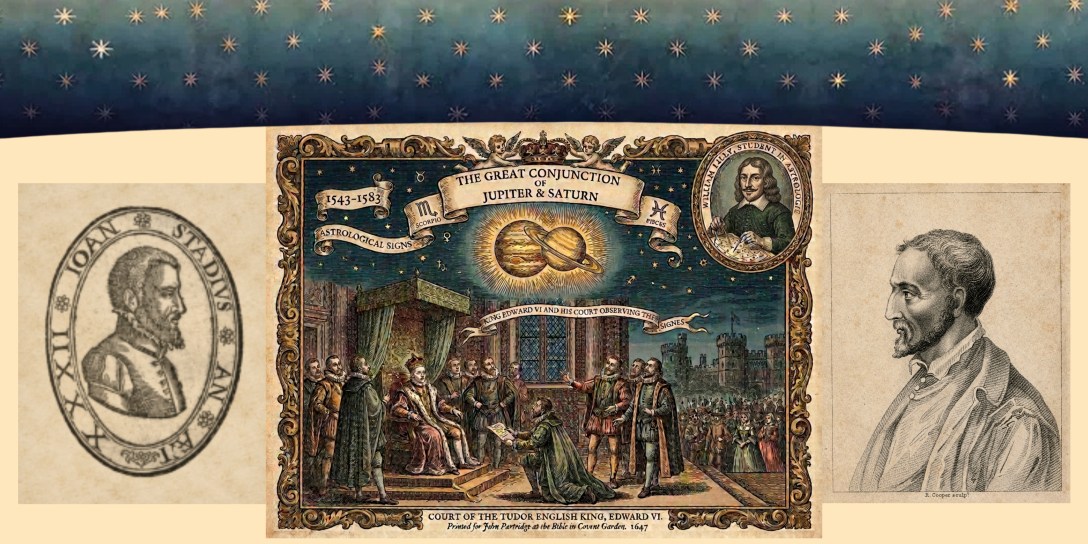
Every twenty years or so, Jupiter and Saturn meet in the sky. For centuries, astrologers have treated these so-called Great Conjunctions as markers of political, religious and cultural eras. Like a new moon, the conjunction itself signals the beginning of a new cycle, whilst the signs in which those meetings occur are thought to shape the character of the age that follows. Yet all cyclical theories of history face the same problem: much like history, astrology is often clearest in hindsight. As we discovered when talking to Marjorie Orr, who wrote a book all about these larger larger planetary cycles, and Christeen Skinner, who has written about America's potential future in one of her books, the challenge often lies in deciding what that hindsight allows us to say about the future. That was the challenge facing William Lilly when, writing his famous treatise on the Jupiter-Saturn cycle amidst the turmoil of the English Civil War, he decided to look back at the Tudor period and concluded that the Great Conjunctions revealed a meaningful pattern in English history. It was also the challenge facing Girolamo Cardano (aka Jerome Cardan) when he returned to Edward VI's horoscope after the young king's death and found meanings he had failed to see the first time around. In this article, I'm going to explore those questions through the lens of the Jupiter-Saturn cycle itself, and in particular the long sequence of water-sign Great Conjunctions that accompanied the rise and fall of the Tudor dynasty. In doing so, we'll revisit the astrology of William Lilly, hear about Girolamo Cardano (Jerome Cardan), Arthurian prophecy, and Andre' Barbault, and see how it all leads back to the surprisingly modern debate about the relationship between calculation and interpretation which Deb and I also get into in the podcast.
