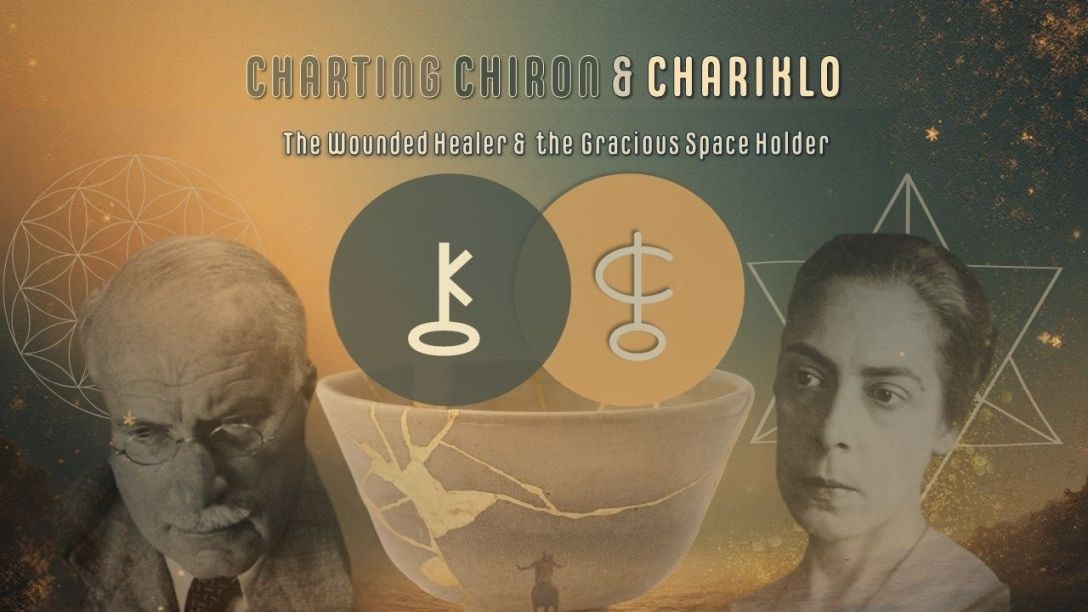
Many people don’t realize that during the devastating Saturn–Pluto conjunction of January 2020 – widely seen by astrologers as an omen of the COVID pandemic – another celestial presence was quietly in attendance. Thanks to the work of astrologers like Melanie Reinhart, we now know that a centaur named Chariklo was there too, bearing silent witness to the unfolding crisis during this cosmic event. In a striking parallel, the Saturn–Pluto conjunction of 1914–15 unfolded against the upheaval of WWI and the Spanish flu pandemic. During this period, Carl Jung - the renowned Swiss psychologist - was quietly unravelling. Supporting him through this period of both external strife and internal turbulence was Toni Wolff, a little-known yet perceptive young woman with a gift for mythology. Together, they developed the groundbreaking ideas and theories that became archetypal psychology. Only years after Jung’s death did the full extent of Wolff’s vital role in those fragile, formative years come to light. Join Sarah Whitridge and I for this bonus episode, the final in Series I of the AstroInsights podcast, where Sarah and I explore the Chiron–Chariklo dynamic through the charts and transits of Eckhart Tolle, Carl Jung, and Toni Wolff. Together, we trace repeating themes in both centaurs’ discovery charts and consider how their stories can guide us in meeting today’s challenges with greater grace.
Author: AstrologySphere
Exploring Sedna’s Significance in Astrology
Beyond Neptune, in the outermost reaches of space, lies a vast, spherical ring of icy bodies and comets known as the Oort cloud - the ancient remnants of our solar system’s formation some 4.6 billion years ago. It is from this distant region in the periphery of our solar system that the trans-Neptunian object Sedna is thought to originate. Her discovery in 2003, at California’s Palomar Observatory, marked a pivotal moment in both astronomy and astrology. A chance conversation with Christeen Skinner about Sedna in July piqued my curiosity about this mysterious planet, and I've been pondering over her significance, both in mundane astrology and in the natal chart, since then. So, what exactly do we know about Sedna the planet? And how/in what context does she tend to show up in natal charts? Aside from talking to astrologers like Ada Pembroke who use Sedna in their client readings, the next best thing is usually to explore how Sedna shows up in the charts of celebrities. That's what I do in this blog post, and in the video (below) I've created especially for subscribers. VIDEO: https://youtu.be/vpZ8UIfnZM0
Sept 2025 Eclipses: Mundane Astrology Forecast with Christeen Skinner
In this special video episode of the Astro-Insights Podcast, financial astrologer, Christeen Skinner, joins me to explore the autumn 2025 eclipses and their potential impact on global markets and geopolitics. Join us as we cover everything from Trump tariffs and world market trends to geopolitics and outer planetary cycles - all through the lens of financial astrology. Perfect for forecasters, finance buffs, and anyone tracking the ebbs and flows of the market.
William Lilly: Prognostication, Power & Free Speech
Known as 'the English Merlin' to his friends and 'that juggling Wizard and Imposter' to his enemies, William Lilly was one of the most well-known and revered political astrologers of 17th century England, who led a colourful life during socially transitional and politically volatile times. The Mystic Meg of his day, Lilly was one of the first conventionally popular astrologers, his fame facilitated by the advent of the printing press and the temporary abolition of censorship laws during the English Civil War and Cromwell Years, which led to a more permissive environment that encouraged more open public discussion and political debate. In this extract from episode six of the Astro-Insights podcast, I look at how freedom of the press aided Lilly's rise to prominence but would eventually also make it personally hazardous to make public predictions, especially if they were not favourable to those in positions of power. An egalitarian and supporter of the populist Parliamentarian cause, Lilly would eventually become disillusioned with the political process and come to agree with his royalist friend, Elias Ashmole, that perhaps sharing too much knowledge, especially with the envious, overly-excitable or the uninitiated, was potentially foolhardy. Given the parallels between the English Civil war and the current geopolitical climate, I thought his experiences might potentially offer us some insights that might prove instructive or illuminating. Watch/listen to the full podcast here: https://youtu.be/qfv7ic-8lpo
Elias Ashmole: The Man vs. the Myth
It's Gemini season (and a Gemini New Moon). And in the spirit of this and it's ruler, Mercury, a planet that is all about liminality and transition, I've decided to change things up a bit. So instead of focusing on yet another astrological transit, I’ve chosen to do an astrological profile on the life and legacy of a famous Gemini and larger-than-life figure in British astrological history - the 17th-century magus and alchemist, Elias Ashmole. Rather than repeat the details of his biography, I've decided to concentrate on the influence of the planet Mercury - and the trickster-like figure of the magician - on Ashmole's life and thinking for this particular blog post. For a fuller biography and some details of his astrological profile, listen to the latest episode of the Astro-Insights Podcast on Spotify or Apple podcasts. Highlights include: * Ashmole's Saturn Return and his initiation into freemasonry, * His friendship with the astrologer, William Lilly; and * His membership of the Royal Society. The YouTube video version, complete with supplementary historical and archival graphics, is available at: https://youtu.be/qqOXbI3hjbs. Or watch the embedded version in the full text of this blog post.
Double-Edged Sword: Uranus into Gemini
On the 7th of July 2025, Uranus - the planet of innovation, technology and revolution, will ingress into curious, communicative and changeable Gemini, where it will remain until 2033, briefly returning to Taurus during its retrograde period between Nov 2025 and April 2026. In this blog post, I examine past trends linked to Uranus in Gemini, as well as make some predictions for the upcoming Saturn-Uranus sextile in August 2025.
Cultivating Empathy & EQ: Jupiter in Cancer
On the 9th of June 2025, Jupiter – the planet of expansion, wisdom and the law – will move into sensitive and caring Cancer, where it will remain until 30 June 2026. In this article, we look at what Jupiter's year-long ingress could mean from a mundane astrology perspective, and offer insights into how to successfully weather the fallout from its challenging upcoming square to Saturn in mid-June 2025.
Adulting: Saturn into Aries
Navigating Conflict: Neptune’s 2025 Ingress into Aries
On 30 March 2025, Neptune will change signs for the first time since 2011, ingressing into focused and self-assured Aries, where it will remain until 2039. Unlike some of the other Neptune in guesses, this one should be quite noticeable because of the stark contrast in emphasis and feel between the soft, nebulous, and enchanting energy of Pisces into the much more sharply defined, individualistic and wilful nature of Aries. These two signs mark the end and beginning of the zodiac. One is watery, open and diffused as boundaries dissolve and we merge with all that is. The other is fiery, highly independent and focused on asserting personal will and defending ego boundaries. So, a marked change in attitudes and worldviews should hardly come as a surprise. Listen or watch Episode 1 in full on Spotify, Apple Podcasts or YouTube.
Tim Walz: Balancing the Ticket?
When Kamala Harris chose a little-known Minnesota governor and Nebraskan-born former teacher to be her candidate for VP on the Democratic ticket, many people wondered what she was thinking. But a few speeches in and a whole lot of good vibes, witty quips and tongue-in-cheek memes later, it's becoming crystal clear why she chose him.… Continue reading Tim Walz: Balancing the Ticket?