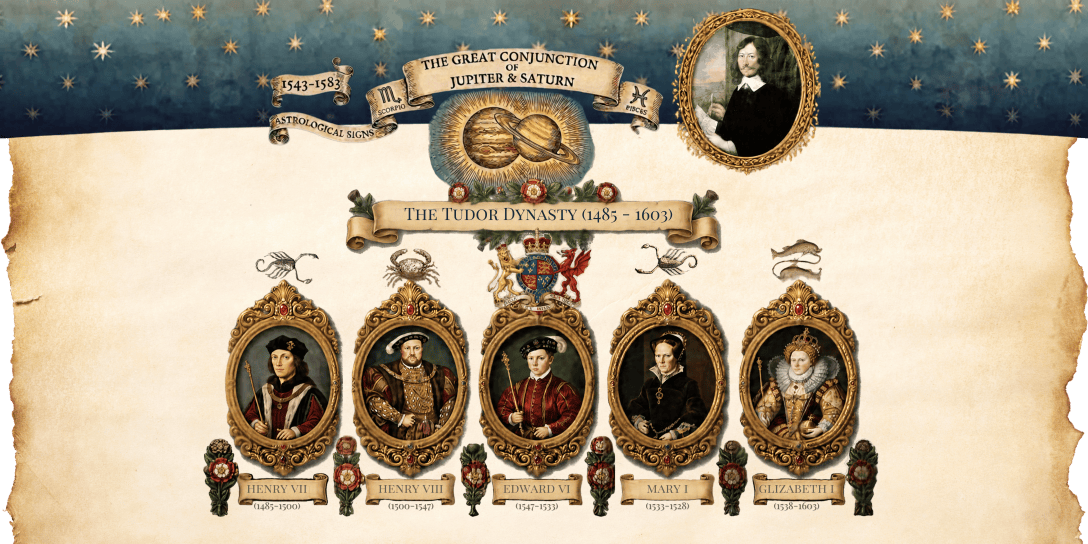
Every twenty years or so, Jupiter and Saturn meet in the sky. For centuries, astrologers have treated these so-called Great Conjunctions as markers of political, religious and cultural eras. Like a new moon, the conjunction itself signals the beginning of a new cycle, whilst the signs in which those meetings occur are thought to shape the character of the age that follows. Yet all cyclical theories of history face the same problem: much like history, astrology is often clearest in hindsight. As we discovered when talking to Marjorie Orr, who wrote a book all about these larger larger planetary cycles, and Christeen Skinner, who has written about America's potential future in one of her books, the challenge often lies in deciding what that hindsight allows us to say about the future. That was the challenge facing William Lilly when, writing his famous treatise on the Jupiter-Saturn cycle amidst the turmoil of the English Civil War, he decided to look back at the Tudor period and concluded that the Great Conjunctions revealed a meaningful pattern in English history. It was also the challenge facing Girolamo Cardano (aka Jerome Cardan) when he returned to Edward VI's horoscope after the young king's death and found meanings he had failed to see the first time around. In this article, I'm going to explore those questions through the lens of the Jupiter-Saturn cycle itself, and in particular the long sequence of water-sign Great Conjunctions that accompanied the rise and fall of the Tudor dynasty. In doing so, we'll revisit the astrology of William Lilly, hear about Girolamo Cardano (Jerome Cardan), Arthurian prophecy, and Andre' Barbault, and see how it all leads back to the surprisingly modern debate about the relationship between calculation and interpretation which Deb and I also get into in the podcast.

Category: Planets
The August ’26 Mutable Eclipse: Market Crashes, Midterms & the End of an Era
When markets look frothy and everyone is chasing the same stock (or story), financial astrologers tend to reach for one planet above all others: Neptune. When negatively aspected, as it is by Mars at the end of August, Neptune can rule loss, bubbles, vapourware and the tempting investment opportunities sold to us that we would all rather not question — and on 28 August, a lunar eclipse in Pisces, Neptune's home sign, brings that whole theme to a head. Not only will this eclipse likely coincide with short-term cycle endings, usually over a three month period, but it will also start the process of closing out a 12-18 month nodal cycle that began in September 2024 and will officially end in February 2027. So the uncomfortable question worth asking is this: could this be the moment the much-predicted AI bubble finally bursts?
Sept 2025 Eclipses: Mundane Astrology Forecast with Christeen Skinner
In this special video episode of the Astro-Insights Podcast, financial astrologer, Christeen Skinner, joins me to explore the autumn 2025 eclipses and their potential impact on global markets and geopolitics. Join us as we cover everything from Trump tariffs and world market trends to geopolitics and outer planetary cycles - all through the lens of financial astrology. Perfect for forecasters, finance buffs, and anyone tracking the ebbs and flows of the market.
Double-Edged Sword: Uranus into Gemini
On the 7th of July 2025, Uranus - the planet of innovation, technology and revolution, will ingress into curious, communicative and changeable Gemini, where it will remain until 2033, briefly returning to Taurus during its retrograde period between Nov 2025 and April 2026. In this blog post, I examine past trends linked to Uranus in Gemini, as well as make some predictions for the upcoming Saturn-Uranus sextile in August 2025.
Cultivating Empathy & EQ: Jupiter in Cancer
On the 9th of June 2025, Jupiter – the planet of expansion, wisdom and the law – will move into sensitive and caring Cancer, where it will remain until 30 June 2026. In this article, we look at what Jupiter's year-long ingress could mean from a mundane astrology perspective, and offer insights into how to successfully weather the fallout from its challenging upcoming square to Saturn in mid-June 2025.
Adulting: Saturn into Aries
Navigating Conflict: Neptune’s 2025 Ingress into Aries
On 30 March 2025, Neptune will change signs for the first time since 2011, ingressing into focused and self-assured Aries, where it will remain until 2039. Unlike some of the other Neptune in guesses, this one should be quite noticeable because of the stark contrast in emphasis and feel between the soft, nebulous, and enchanting energy of Pisces into the much more sharply defined, individualistic and wilful nature of Aries. These two signs mark the end and beginning of the zodiac. One is watery, open and diffused as boundaries dissolve and we merge with all that is. The other is fiery, highly independent and focused on asserting personal will and defending ego boundaries. So, a marked change in attitudes and worldviews should hardly come as a surprise. Listen or watch Episode 1 in full on Spotify, Apple Podcasts or YouTube.
Plutopia or Plutocalypse?
Eclipse Forecast: Six Month Market Outlook
In this video forecast, designed to look at the outlook for the six months following the May 2022 Solar Eclipse in Taurus, I weigh up the probabilities from both Gann cycles and astrology in conjunction with more conventional forms of technical analysis, to ascertain whether we are likely to see a final top before the… Continue reading Eclipse Forecast: Six Month Market Outlook